Platform Engineering, Explained as a Factory Line
Most engineers have heard platform engineering described as “DevOps, but with a portal.” That description undersells what’s actually happening. The clearest way to see what a strong Internal Developer Platform (IDP) really does is to stop thinking about it as tooling and start thinking about it as a factory line.
From Custom Operator to Self-Service Production Line
A platform team’s job looks a lot like building an automated factory: a product planner and an automotive engineer sit down focused entirely on customer needs, and design a line that lets any product team manufacture, ship, and operate their own service — without waiting on a specialist to do it by hand every time.
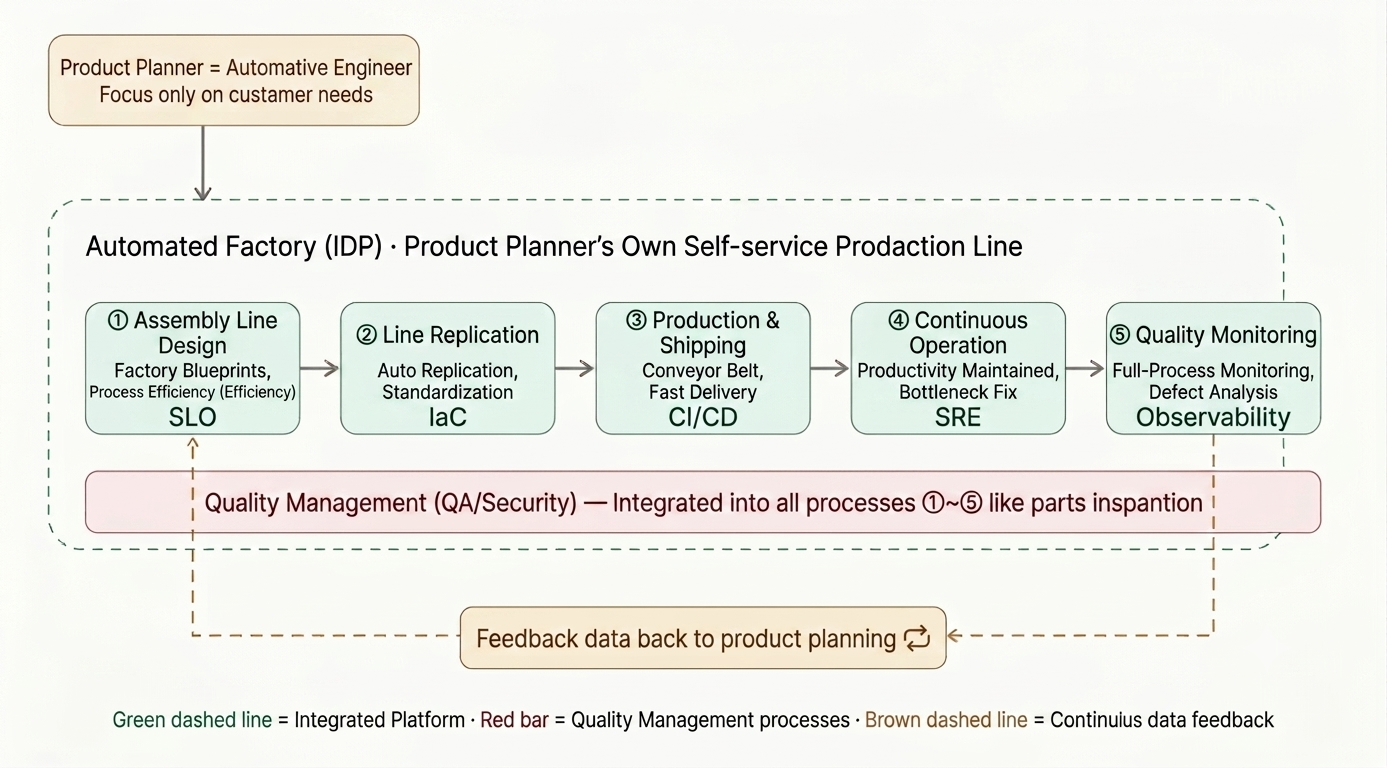
The diagram below maps that factory line directly onto the stages of platform engineering:
Walking the Line, Station by Station
1. Assembly Line Design → SLO
Before you can replicate anything, you need a blueprint: what does “built correctly” mean for this factory line? In platform terms, that blueprint is the Service Level Objective. It defines process efficiency and the quality bar every unit coming off the line has to meet — before a single part gets made.
2. Line Replication → Infrastructure as Code
Once the blueprint exists, you don’t redraw it by hand for every new product. You replicate the line automatically. This is Infrastructure as Code: standardized, repeatable environments that let a new service get its own production line in minutes, not weeks of manual setup.
3. Production & Shipping → CI/CD
The conveyor belt that actually moves a part from raw material to a shipped product is CI/CD. Fast, automated, and the same belt every team uses — so “how do I ship this” stops being a question anyone has to ask a platform engineer.
4. Continuous Operation → SRE
A factory line doesn’t stop the moment the product ships — someone has to keep the line itself running, watch for bottlenecks, and fix them before they stall production. That’s SRE: maintaining productivity and resolving bottlenecks in the platform itself, not just in any one service.
5. Quality Monitoring → Observability
At the end of the line, every unit gets inspected. Observability is that full-process inspection and defect analysis — the platform’s way of catching a flaw before it reaches the customer instead of after.
The Part That Touches Everything: Quality Management
Quality Management (QA/Security) isn’t drawn as a station at the end of the line — it’s the red bar running underneath stations ① through ⑤. It gets integrated into every stage, the same way parts inspection happens continuously on a real assembly line, not just once at final packaging. A platform that bolts security on as a last step before shipping isn’t really platform engineering — it’s a checklist.
The Loop That Makes It a Platform, Not Just a Pipeline
The final piece is the brown dashed line: feedback data flows back to product planning. A real IDP doesn’t just produce services — it produces data about how those services perform, where developers get stuck, and where the line itself needs redesigning. Without that loop, you’ve built faster shipping. With it, you’ve built a platform that improves itself.
Where This Connects in the Playbook
If you’re scoring your own platform engineering competency, this factory-line view maps directly onto the proof points in Platform Engineering & Internal Developer Platforms: the golden path is the blueprint, the IDP portal is the replication mechanism, and the feedback loop is exactly what separates a Senior from a Principal on that page’s maturity table.